
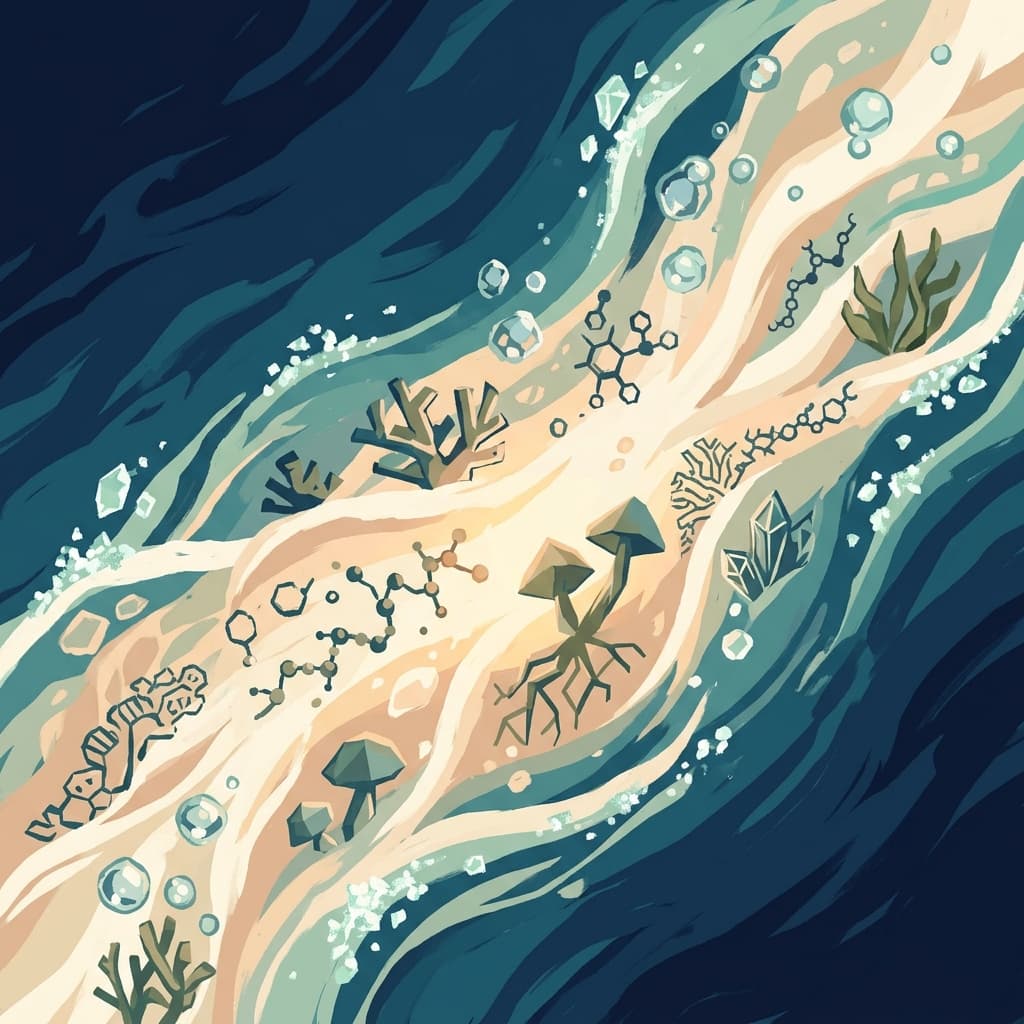
Course · 8 lessons · ~1h 44m
Nature-Based Solutions for Climate Risk Mitigation
After this course you can apply nature-based solutions to mitigate climate-driven landslide and erosion risks.
By the end, you'll be able to
- [01] Comprehensive Explanation of Nature-Based Solutions (NBS)
- [02] Bio-cementation strategy
- [03] Use of Fungi in Soil Stabilization
- [04] Bio-Based Polymers for Soil Improvement
Curriculum
8 lessons- 01[01] Comprehensive Explanation of Nature-Based Solutions (NBS)Laying the crucial groundwork by providing core definitions, tracing the history of NbS concepts, and breaking down their types and benefits.It outlines how climate change forces a shift away from traditional weather "stationarity" and addresses the four major consequences: soil erosion, landslides, floods, and droughts.
- 02[02] Bio-cementation strategyExploring the intersection of biology and engineering.It focuses on Microbially Induced Calcite Precipitation (MICP)—a sustainable soil-stabilization technique using ureolytic bacteria (like Sporosarcina pasteurii ) to produce a natural mineral "glue" that binds loose particles together.
- 03[03] Use of Fungi in Soil StabilizationMoving from bacteria to the underground world of fungi.It dives into how filamentous fungi grow a complex, three-dimensional vegetative network of microscopic branching filaments (mycelium and hyphae) to weave through and reinforce soil structures.
- 04[04] Bio-Based Polymers for Soil ImprovementStabilizing the ground using the non-living biological molecules that organisms produce.It highlights renewable, biodegradable biopolymers—classified into plant-based (guar gum), animal-derived (chitosan), and microbial (xanthan gum) families—and how their chemical mechanisms physically bind or coat coarse and unstable soils.
- 05[05] Vegetation-Based Slope StabilizationMoving above ground to "living engineers"—grasses, shrubs, and trees.It covers the mechanics of root reinforcement as a "two-for-one" deal: providing a mechanical physical net (like the deep roots of Vetiver grass) and performing a hydrological role by pumping water out to keep soil from getting mushy
- 06[06] Natural Ground Covers and Organic Mulching SystemsHow to treat bare ground that needs a quick biological "bandage".It explains how applying layers of organic mulch (like wheat straw, wood chips, or compost) or inorganic armor creates a protective skin that regulates moisture, regulates soil temperature, and stops erosion in its tracks.
- 07[07] Watershed Management and Natural Water Control SystemsZooming out from individual hillsides to the broader landscape's "circulatory system".It discusses managing water across entire landscapes using natural water control systems rather than massive concrete dams, helping the terrain behave like a giant sponge to avoid catastrophic slope failures.
- 08[08] Role of Local Community Participation in Landslide Risk ReductionThe human element of NbS.It wraps up the series by explaining that nature-based solutions are living systems requiring a "social contract".It outlines a connected chain of action called Mosaic Governance —linking academia, policy, local citizens, and educators to ensure long-term maintenance and generational risk awareness.
Feedback
Is this the course you were looking for?
Your instructor
Mitigation of extreme events due to climate change through Nature Based Solutions (NbS)
This eight-part series explores how we can leverage the inherent power of natural systems to protect our infrastructure, communities, and environments from the escalating impacts of climate change.Built for land managers, infrastructure designers, earth material analysts, and natural resource protectors, this podcast keeps things practical, technical, and grounded in reality. Co-hosted by researchers Ali and Kimia, the series bridges the gap between laboratory data, geotechnical engineering, and living ecosystems to explain how we can move away from traditional construction and start building with the Earth.
Start the course
8 lessons · ~1h 44m. Free, no signup.
More in STEM & Exam Prep
See all
AQA GCSE Biology: Cell Biology Foundations
Review the AQA cell biology sequence from cells through transport.
AQA GCSE Biology: Organisation, Enzymes, and Health
Complete the next AQA biology review arc around organisation, enzymes, and health.
 Italian
Fisiologia animale negli ambienti estremi
Capirai come il corpo degli animali sopravvive senza ossigeno, al freddo, al caldo, al buio, alle migrazioni e alla pressione dell'uomo.
 Italian
Neuroscienze cognitive: dentro la vita della ricerca accademica
Capirai come si svolge davvero la ricerca accademica e coglierai le idee fondamentali che collegano cervello, corpo, apprendimento e comportamento.